
Knee Replacement Recovery at Home – Timeline and Care Tips
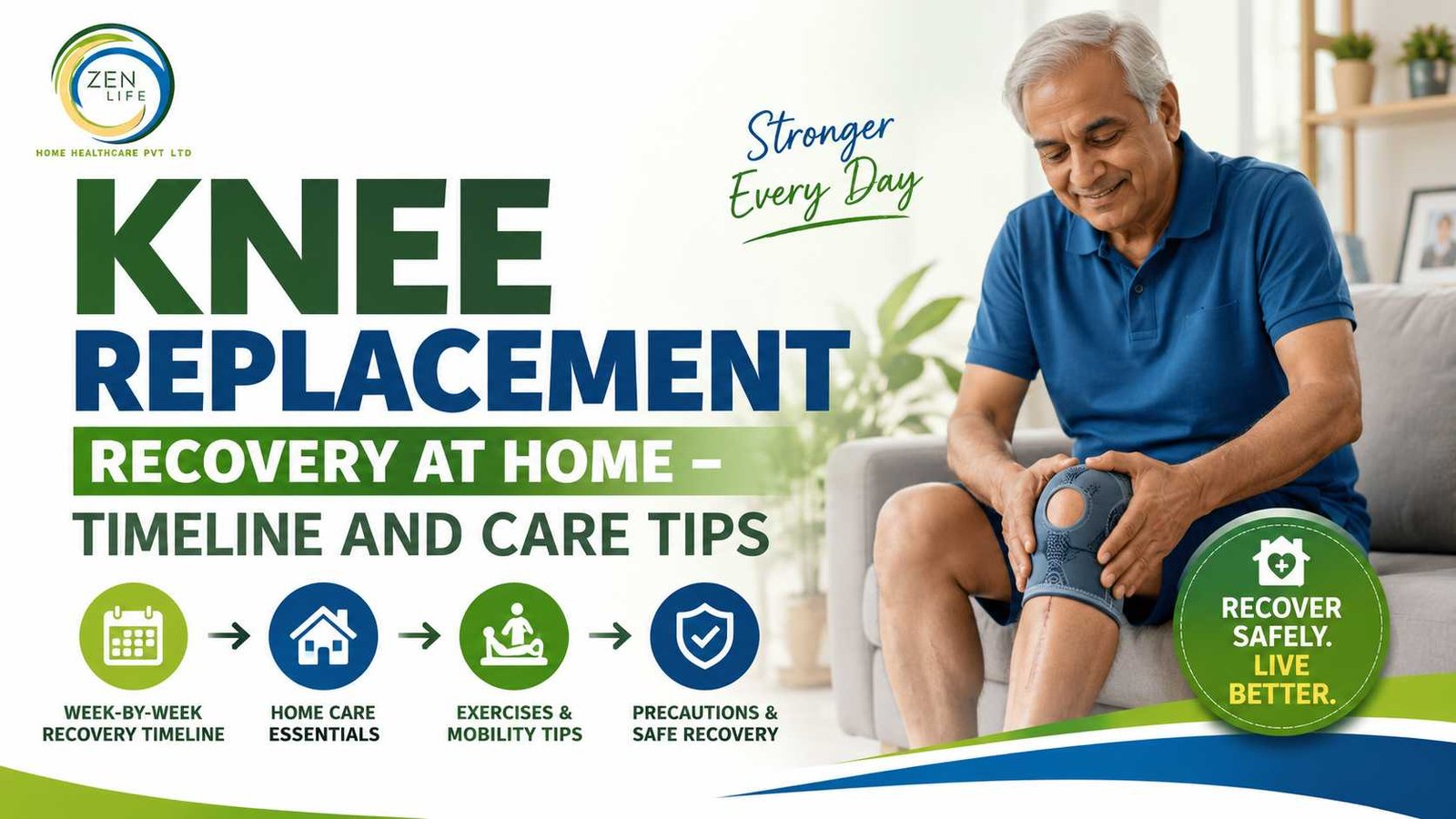
Getting a knee replaced is a big decision. And while the surgery itself takes only a few hours, the real journey begins the moment you come back home. Thousands of patients every year ask the same questions — How long will recovery take? What should I do at home? When will the pain stop?
If you or your loved one is preparing for or recovering from knee surgery, this complete guide on knee replacement recovery at home — timeline and care tips is written just for you. At Zenlife Home Healthcare Pvt Ltd, we have helped hundreds of patients heal safely and comfortably at home, and we are sharing everything we know right here.
Understanding Knee Replacement Recovery at Home
After surgery, most patients are discharged within 2 to 4 days. From that moment, your home becomes your rehabilitation centre. The quality of your knee replacement recovery at home — the care you take, the exercises you do, the warning signs you watch for — directly impacts how fast and how well you heal.
Recovery is not just about waiting. It is about doing the right things every single day.
The good news? With proper support and home care, most patients recover very well and go back to a normal, pain-free life within 3 to 6 months.
Knee Replacement Recovery Timeline — Week by Week
Understanding the knee replacement recovery timeline by week helps you set realistic expectations. You will have good days and hard days. Knowing what is normal at each stage makes all the difference.
First 24 Hours After Knee Surgery
The first 24 hours after knee surgery are all about rest, monitoring, and very gentle movement. You will likely still be in the hospital during this window, but some patients are discharged on the same day.
Here is what typically happens:
- Pain and swelling are at their highest. This is completely normal.
- Nurses or physiotherapists will help you stand and take a few steps — usually with a walker.
- Blood thinning medication is given to prevent clots.
- Ice packs may be applied to manage initial swelling.
- You will begin very gentle ankle pumps to keep blood circulating.
Do not panic about the pain. Your body is healing. Medications will help manage it.
Week 1 to 2 — The Foundation Phase
This is the most challenging part of your knee replacement home recovery. The focus here is safety, rest, and preventing complications.
What to expect:
- Significant swelling, bruising, and redness around the knee (this is normal)
- Pain that gradually begins to reduce with medication
- Learning to move safely with a walker or crutches
- Short physiotherapy sessions starting at home
How long to walk after knee replacement? Most patients begin walking short distances — just a few steps — within 24 hours. By the end of week 2, many people can walk 10 to 15 minutes with support.
Key goals for this phase:
- Keep the leg elevated as much as possible
- Do the gentle exercises your physiotherapist has prescribed
- Attend all follow-up appointments
- Take medications on time
Week 3 to 6 — The Progress Phase
This is where you start to feel the improvement. The knee replacement recovery timeline shows real forward movement here.
- Swelling begins to reduce noticeably
- You may transition from a walker to a single cane
- Walking distance increases slowly but steadily
- Range of motion begins to improve with daily exercises
- You can manage most daily activities with minimal help
Many patients want to do too much too fast during this phase. Resist that temptation. Overdoing it can cause setbacks. Slow and steady wins the race here.
Month 2 to 3 — Building Strength
By the second and third months, most patients cross important knee recovery milestones:
- Walking without any support device for short distances
- Climbing stairs with support
- Driving may become possible (see below)
- Pain is significantly reduced, though mild aches may persist
- Physical therapy sessions become more intensive
When can I drive after knee replacement? Most surgeons say you can drive again around 4 to 6 weeks after surgery — but only if it is your left knee and you drive an automatic car, or after 6 to 8 weeks if it is your right knee. Always confirm with your doctor before getting behind the wheel.
Month 4 to 6 — Near Full Recovery
This is the home stretch. The typical healing time for total knee replacement is generally considered to be 3 to 6 months for most daily activities, though complete internal healing of the bone and tissue can take up to a year.
By month 6:
- Most patients walk comfortably without a cane
- You can return to low-impact activities like swimming or cycling
- Pain is mostly gone or very manageable
- Joint function is close to normal
Setting Up Your Home for a Safe Recovery
One of the most important steps you can take before surgery is preparing your home. A proper setup makes knee replacement recovery at home much safer and more comfortable.
Knee Replacement Home Recovery Checklist
Use this checklist to get your home ready:
- ✅ Remove all rugs, loose mats, and clutter from walkways
- ✅ Set up a sleeping area on the ground floor (to avoid stairs)
- ✅ Install grab bars in the bathroom near the toilet and shower
- ✅ Get a raised toilet seat to make sitting and standing easier
- ✅ Place frequently used items at waist height — no bending or reaching
- ✅ Have a sturdy chair with armrests for sitting and getting up
- ✅ Keep a reacher/grabber tool handy
- ✅ Set up good lighting in all rooms, especially at night
How to Set Up the Bedroom for Knee Surgery
Your bedroom setup matters a lot. How to set up the bedroom for knee surgery properly:
- The bed should be at a comfortable height — not too low (hard to get up) and not too high (hard to get in)
- Keep water, phone, medications, and TV remote within arm’s reach
- Place a firm pillow under your knee when sleeping on your back
- Use extra pillows to support the leg when resting
Best Equipment for Knee Surgery Recovery
Your doctor or physiotherapist will advise you, but the best equipment for knee surgery recovery typically includes:
- Walker or crutches — for the first few weeks
- Raised toilet seat — reduces strain on the new joint
- Shower chair — for safe bathing
- Long-handled sponge and shoehorn — to avoid bending
- Ice pack or cold therapy wrap — for swelling management
- Compression stockings — to prevent blood clots
- Leg elevation pillow — to reduce swelling
According to guidelines from the Ministry of Health and Family Welfare, Government of India, post-surgical home care, proper environment setup, and physiotherapy are key pillars of a successful joint replacement recovery.
Managing Pain and Swelling at Home
Pain and swelling are the two biggest challenges in the early weeks of recovery. Here is how to manage them effectively.
How to Reduce Knee Swelling at Home
Swelling is your body’s natural healing response, but too much swelling can slow recovery. These tips help reduce knee swelling at home:
- Elevate the leg above heart level for 15 to 20 minutes, several times a day
- Apply ice packs — one of the most effective tools you have
- Do gentle ankle pumps — they push fluid away from the knee
- Stay hydrated — proper hydration helps the body manage inflammation
- Avoid standing or sitting in one position for too long
Ice Pack Tips for Knee Recovery
Ice pack tips for knee recovery:
- Apply ice for 15 to 20 minutes, not more (to avoid skin damage)
- Always wrap the ice pack in a thin cloth — never apply directly to skin
- Use it after exercise or physiotherapy sessions for best results
- Cold therapy is most effective in the first 2 to 3 weeks
Managing Pain After Total Knee Replacement
Managing pain after total knee replacement is a team effort between you, your doctor, and your caregiver. Some tips:
- Take prescribed pain medication exactly as directed — do not skip doses
- Do not wait for pain to become severe before taking medication
- Use a pillow to support the knee when resting or sleeping
- Gentle movement actually helps — do not stay completely still
Normal vs Abnormal Pain After Knee Surgery
It is important to understand what is normal vs abnormal pain after knee surgery:
Normal: Aching pain around the knee, mild throbbing, pain that reduces with rest and medication, some pain during exercises.
Abnormal (call your doctor): Sharp, sudden increase in pain, severe pain that does not respond to medication, pain accompanied by fever or chills, pain with redness and warmth that is spreading.
Natural Ways to Lower Joint Inflammation
Beyond medications, these natural ways to lower joint inflammation support your healing:
- Eat anti-inflammatory foods — turmeric, ginger, leafy greens, omega-3-rich fish
- Avoid processed foods and excess sugar
- Stay hydrated
- Get adequate sleep — your body does most of its healing while you sleep
- Light breathing exercises reduce stress, which can worsen inflammation
Home Exercises and Mobility for Knee Recovery
Exercise is not optional in knee replacement recovery at home — it is essential. But the exercises must be gentle, consistent, and approved by your physiotherapist.
Gentle Knee Exercises for Home Recovery
These gentle knee exercises for home recovery are commonly recommended in the early weeks:
- Ankle Pumps — Flex and point your foot up and down. Do 20 reps, 3 times a day.
- Quad Sets — Tighten the thigh muscle with the leg straight. Hold 5 seconds, 10 reps.
- Heel Slides — Lying on your back, slowly slide the heel towards the buttocks and back.
- Straight Leg Raises — Lift the leg 6 to 10 inches off the bed with the knee straight.
- Seated Knee Flexion — Sitting in a chair, gently bend and straighten the knee.
How to Regain Range of Motion at Home
How to regain range of motion at home is one of the most common concerns. The knee must be able to bend at least 90 degrees for most daily activities. Tips:
- Do your prescribed exercises every day without fail
- Never force the knee beyond a comfortable range
- Consistency beats intensity — short sessions multiple times a day work better than one long session
- Warm the joint slightly before exercises with a warm cloth
Walking Tips After Knee Replacement
Walking tips after knee replacement:
- Always use your walker or cane when prescribed — never skip it
- Walk on flat, even surfaces in the early weeks
- Take small, deliberate steps — do not rush
- Gradually increase walking distance each day
- Wear supportive, flat-soled footwear
Best Stretches for Stiff Knee After Surgery
How to stop knee stiffness at home and the best stretches for stiff knee after surgery:
- Wall slides — excellent for gentle range-of-motion improvement
- Seated hamstring stretch — while sitting on a chair, extend one leg and gently lean forward
- Calf stretch — standing at a wall, gently push the heel down
Stiffness is most common in the morning. Gentle movement right after waking can loosen the joint effectively.
How to Use a Walker After Knee Replacement
How to use a walker after knee replacement safely:
- Push the walker slightly forward before stepping into it
- Step with the operated leg first when moving forward
- Do not bear too much weight on the walker — it is for support, not full weight bearing
- Never lift the walker — always slide it or pick up all four legs together
Daily Living Tips During Recovery
Showering After Knee Replacement Surgery
Showering after knee replacement surgery is possible but requires care:
- Use a shower chair to avoid standing fatigue
- A handheld showerhead makes it much easier
- Keep the incision site dry until your doctor clears it
- Non-slip mats inside and outside the shower are a must
- Have someone nearby for the first few showers
Sleep Positions After Knee Replacement
Sleep positions after knee replacement:
- Sleeping on your back with a pillow under the ankle (not under the knee — this can cause a fixed bent position)
- Avoid sleeping on your stomach in early recovery
- Side sleeping is possible with a pillow between the knees
- Do not sleep with the knee in a fully bent position for long periods
Home Safety Tips After Joint Replacement
Home safety tips after joint replacement include:
- Install a night light in hallways and bathrooms
- Wear non-slip slippers — never walk in socks alone
- Keep pets from underfoot during early recovery
- Have an emergency contact or caregiver available, especially at night
Warning Signs — When to Call the Doctor
This is critical. Knowing the warning signs after knee replacement surgery can save your life. Do not ignore these.
Signs of Blood Clots in Legs After Surgery
Signs of blood clots in legs after surgery (DVT — Deep Vein Thrombosis):
- Swelling in one calf or leg that is noticeably more than the other
- Redness, warmth, and tenderness in the calf area
- Pain in the calf that is worse when you flex the foot
This is a medical emergency. Call your doctor immediately.
According to the Centers for Disease Control and Prevention (CDC), DVT is a serious but preventable complication after joint replacement surgery. Blood thinners and movement are key prevention strategies.
Warning Signs of Pulmonary Embolism
If a blood clot travels to the lungs, it causes a pulmonary embolism — a life-threatening emergency. Warning signs of pulmonary embolism:
- Sudden shortness of breath
- Chest pain, especially when breathing deeply
- Rapid heartbeat
- Coughing up blood
- Feeling faint or dizzy
Call 112 or go to the nearest emergency room immediately if you experience any of these.
Knee Replacement Infection Symptoms at Home
Knee replacement infection symptoms at home to watch for:
- Increasing redness, warmth, or drainage from the wound
- Fever above 38.5°C (101.3°F)
- Wound that smells unusual or has cloudy discharge
- Pain that is getting worse instead of better
When to Call the Doctor After Knee Replacement
When to call the doctor after knee replacement:
- Any of the infection or blood clot signs above
- Sudden severe pain not controlled by medication
- Numbness or tingling in the foot
- Inability to bear any weight after previously being able to
- Knee feels loose, unstable, or gives way
How to tell if knee surgery failed — rare but possible signs include persistent severe pain beyond 3 months, no improvement in mobility, or mechanical issues like clicking with pain. If something feels seriously wrong, do not ignore it. Trust your instincts and contact your care team.
Normal Redness and Bruising After Joint Surgery
Do not panic about every bruise. Normal redness and bruising after joint surgery includes:
- Bruising that spreads down the leg in the first 1 to 2 weeks — this is gravity moving old blood and is harmless
- Mild pinkness around the incision as it heals
- Some warmth near the joint for several weeks
These are all part of normal healing.
How Zenlife Home Healthcare Supports Your Recovery
At Zenlife Home Healthcare Pvt Ltd, we believe that where you heal matters as much as how you heal. Our team of trained nurses, physiotherapists, and care assistants come to your home so you can recover in the comfort and safety of your own environment.
Our home-based knee replacement recovery support includes:
- Trained physiotherapists who guide you through every exercise stage
- Skilled nurses for wound care, medication management, and monitoring
- 24/7 caregiver support for assistance with daily activities
- Doctor teleconsultation coordination for follow-ups
- Medical equipment rental — walkers, wheelchairs, hospital beds, and more
We are committed to making your recovery as smooth, safe, and swift as possible — right from the comfort of your home.
Ready to plan your recovery? Contact Zenlife Home Healthcare today and speak with our care coordinator. We are here to help every step of the way.
Final Thoughts
Knee replacement recovery at home — the timeline and care tips we have shared in this guide are built on real clinical experience and compassionate care. Recovery is a journey, not a race. Some days will feel like setbacks — and that is okay. What matters is that you stay consistent, follow your care plan, and reach out for help when you need it.
You do not have to do this alone.
Zenlife Home Healthcare Pvt Ltd is here to walk beside you — literally and figuratively — every step of your recovery journey.
Frequently Asked Questions (FAQs)
Most patients are back to regular daily activities within 3 to 6 months. Full internal healing may take up to 12 months.
Yes — for most patients, home is the best place to recover. With proper support, home recovery is safe, comfortable, and effective.
Yes, but usually after 2 to 4 weeks and with supervision. Always lead with the non-operated leg going up, and the operated leg going down.
Anti-inflammatory foods like turmeric, ginger, salmon, leafy greens, berries, and nuts support healing. Avoid processed food, excess salt, and alcohol.
Most swelling reduces significantly by 3 months. Some mild swelling can persist for up to a year — this is normal.

How to Care for a Bedridden Patient at Home: A Complete Guide to Preventing Bedsores & Daily Care
How to Care for a Bedridden Patient at Home: A Complete Guide to Preventing Bedsores & Daily Care Caring for a bedridden patient at home centers on four things: repositioning

How to Use a BiPAP/CPAP Machine at Home Safely: A Complete Care Guide
How to Use a BiPAP/CPAP Machine at Home Safely: A Complete Care Guide If your doctor has just prescribed a BiPAP or CPAP machine for you or your elderly parent,

Complete Guide to Parkinson’s Patient Care at Home in Lucknow
Complete Guide to Parkinson’s Patient Care at Home in Lucknow Parkinson’s disease is one of those conditions that slowly changes daily life — not just for the patient, but for

Caring for a Paralysis Patient at Home: A Complete Family Guide (2026)
Caring for a Paralysis Patient at Home: A Complete Family Guide (2026) When a loved one is suddenly paralysed — after a stroke, an accident, or a spinal injury —

7 Essential Home Health Checks Every Senior Should Do Monthly
7 Essential Home Health Checks Every Senior Should Do Monthly Staying healthy doesn’t always require a doctor’s visit. In this video, “7 Essential Home Health Check Every Senior Should Do

Dementia Care at Home: A Complete Guide for Families
Dementia Care at Home: A Complete Guide for Families Understanding Dementia Dementia is not a single disease but an umbrella term for a group of progressive neurological conditions that affect